
BROWNFIELD ENGINEERING
Evolving and diagnosing production systems
Brownfield maintenance based on understanding existing behavior before changing it.
Context and problem
A significant part of my professional work involves existing systems. These are applications with users, accumulated data, and behaviors built over years. An apparently small task may require understanding other people's code, reconstructing dependencies, and determining which assumptions remain valid under newer runtime or database versions.
This experience spans different existing systems and upgrade processes to PHP 8 and later versions. The specific goal is to keep them operational, correct a behavior, make them compatible with a newer environment, or introduce a change while preserving what already works.
My responsibility and constraints
My responsibility is to analyze reported problems, locate their source, reproduce them when possible, implement changes, and then validate that the system retains the expected behavior. I work on existing implementations; this does not imply that I developed the original system.
These systems contain real data, dependencies, and historical conventions. Other components may rely on behavior that is not immediately obvious, so I avoid broad changes before understanding the specific problem.
Investigation method
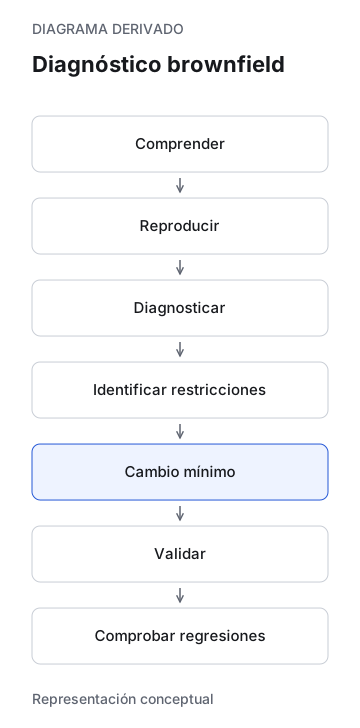
The process is understand → reproduce → diagnose → identify constraints → modify → validate regressions. First, I try to understand existing behavior and reproduce the problem when possible. Diagnosis helps identify assumptions and constraints before deciding what to change.
The intervention must be proportionate to the problem. After the change, I revisit the affected workflow and review relevant side effects: fixing the initial error is not enough if another system behavior is altered.
Microcase: insertion with AUTO_INCREMENT
A legacy operation inserted records whose identifier used AUTO_INCREMENT. The shared helper sent an empty string ('') for that integer field. The previous environment had accepted that value; after an upgrade with stricter runtime and database configuration, it started producing the error Incorrect integer value: ''.
Diagnosis traced the problem to a historical assumption in a shared layer, rather than the entire creation feature. The change was deliberately small: the helper began sending NULL instead of '' when the database needed to generate the field automatically, delegating that generation to MySQL.
I then ran the affected workflow again and checked for possible duplicate insertions or other side effects.
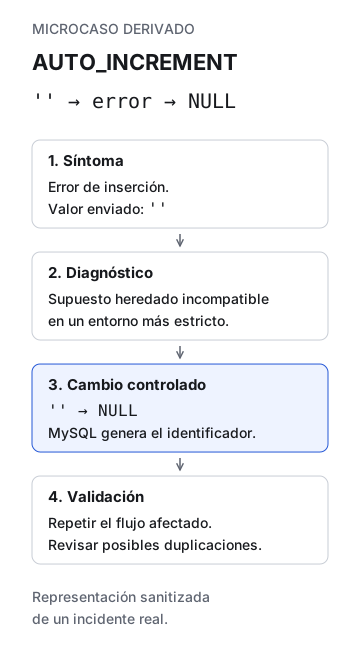
'' → error → NULL and the subsequent validation.Outcome and validation
The change eliminated the insertion error and allowed the workflow to work again in the updated environment. Subsequent validation covered the behavior that had failed and the review of relevant side effects, such as possible duplicate records.
This validation covers the affected workflow and its possible relevant regressions; it is not a general guarantee about all system behaviors.
What it demonstrates
- Reading other people's code and reconstructing inherited assumptions before intervening.
- Diagnosing compatibility issues between existing behavior and an updated environment.
- Choosing a proportionate intervention: a small change supported by precise analysis.
- Validating the corrected workflow and reviewing possible regressions, rather than stopping when the initial error disappears.
The central principle is to diagnose correctly before writing code.
Technology and evidence
- PHP
- SQL
Technology and practices: PHP / PHP 8+ · SQL · relational databases · debugging · migrations · existing code analysis · regression validation.
This account is backed by private professional evidence of systems, maintenance code, fixes, and validation during upgrades. The public diagram is a conceptual derivative of the diagnosis process, rather than a reproduction of a particular system.
Privacy note
PRIVATE PRODUCTION SYSTEM
Internal names, data, code, and configuration are not published. The example is reduced to its essential technical behavior, without exposing details of private systems or linking institutional resources.